Showing posts with label book reviews. Show all posts

Monday, April 13, 2015

Book Review [2015:12] The Winter Garden by Jane Thynne


432 pages

This is the second of the Clara Vine novels, which I discovered earlier this year when I read Black Roses. 

The year is now 1937, and Clara remains in Berlin which has changed considerably for the worse since the early 30s of the first book. Clara continues to tread a dangerous tightrope, feeding information to the British Secret Services and also to the Nazis via Joseph Goebbels (a complex double bluff). The focus of this book has moved slightly from the fascinating Magda Goebbels and on to the bizarre and notorious Nazi Bride Schools. It's not a topic I know much about and the incidental characters in the bride school are well drawn and the experience very believably described.
Again, Clara is confronted with the apparent murder of one of her acquaintances and has to tread carefully to try and determine the truth in a complex world of Nazi smoke and mirrors. Clara now has care of the son of one of her friends and this is a really good addition to her character, as she has to deal with his fascination with the Hitlerjugend without compromising her beliefs.

Thynne bravely continues to introduce real characters into the story, this time involving The Duke of Windsor and Wallis Simpson, The Mitford Sisters and Charles Lindburgh, as well as Eva Braun and Ernst Udet. I often find that sort of contrivance frustrating and false, but such is Thynne's ability as a writer that they pass into and out of the story, often as rather believable sideshows, and the wonderful Clara often doesn't pay them too much attention, not realising their significance until later. Unity Mitford in particular is such a marvellous addition. Clara's unwitting stumbling into the lives at centre of the Third Reich proves a brilliant foil for some amusing background stories.

The complex story of the progression to the second world war is handled competently and the war in Spain is weaved into this story without becoming too much of a historical exposition. Clara's character is totally believable and her behaviour having found herself in this rather dangerous, unpredictable situation never seems too fictional. I did balk slightly at the central premise of one of the main points of the plot which I won't discuss to avoid spoilers, but such is the joy of Thynne's writing all was quickly forgiven.


I'm really enjoying this series of books, and I look forward to the third!

Book Review [2015:11] Tamara Drewe by Posy Simmonds


136 pages

I have a warm place in my heart for Tamara Drewe. For me it conjures memories of happy times reading the paper over a slow weekend. It's the first comic strip that I followed week on week, and I loved it. D bought me the book for Valentine's this year and I have happily settled down to reread and reminisce.
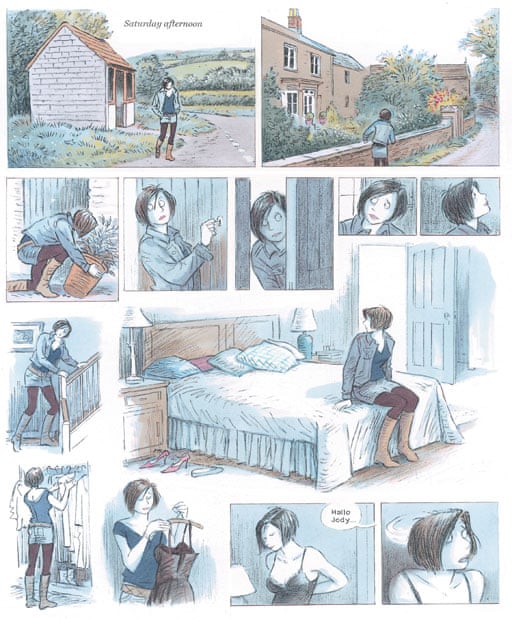
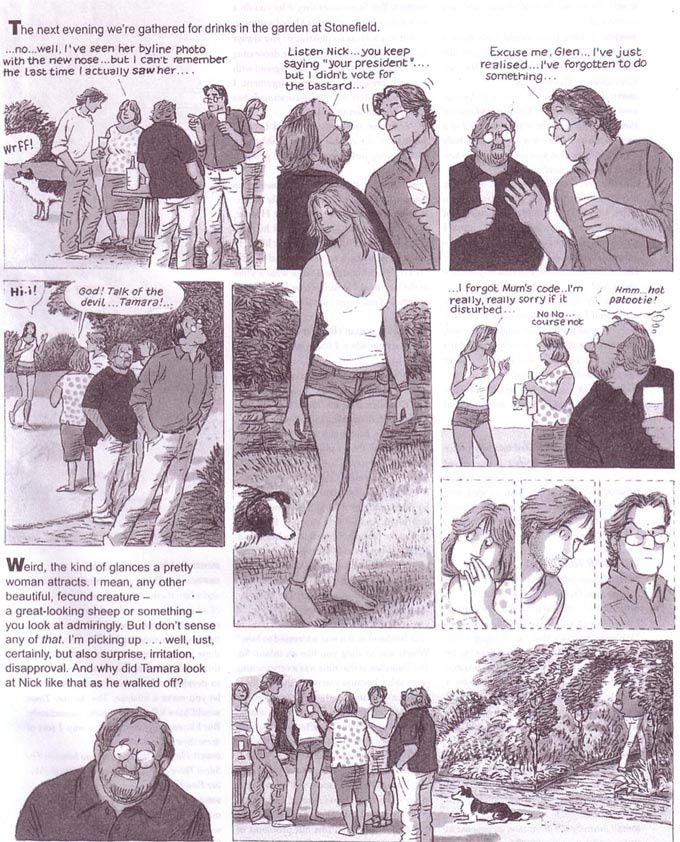
This is what I think you are meant to call a graphic novel, which means a comic for grown-ups. I'm not going to pretend to be some sort that is knowledgable about such things but I really love Simmonds' creation, and not just for nostalgia. Her drawings are actually beautiful. Every single panel! Have a look at these two pages:


All the characters look like real people and the writing and storyline is totally engrossing. Her observation of naughties life is so perfect, particularly the teenagers. Each character has a depth that you don't always find in 'normal' novels. Is this because you can see them as well as read their stories?  
When I first read the comic strip in the paper, I didn't recognise the story as Hardy's Far From the Madding Crowd. I'm sure I'd read it before that time but the conversion to modern day is so well done you don't immediately harken back to the original. Hardy's tale happens to be one of my favourite classics, so perhaps there was a subconscious attachment to the tale. In any case Simmonds has created something quite wonderful here, and it's worth a read if you get the chance. It's absolutely a keeper and I will enjoy it again.


On a side note I enjoyed the movie of this book as well, and I thought the characters were extremely well cast, and true to the book. It's worth a watch if you can!

Monday, March 09, 2015

Book Review [2015:10] The White Pearl by Kate Furnivall

http://www.amazon.co.uk/The-White-Pearl-Kate-Furnivall/dp/0751543365

448 pages

The first few chapters of this book are terrible. I actually gave up on it the first time around, the first chapter in particular really put me off.  What kept me from ditching it completely was the fact that the blurb on the back didn't seem to match at all the style or substance of the beginning of the story. It was this incongruence that led to me trying again. I'm pleased I stuck with it!
The story is set in Malaya in 1941 and is centred around Connie Hadley, wife of a successful rubber plantation owner (although parts of the story are told from other character's points of view, Connie is the main protagonist). Connie is a naive Imperial wife at the beginning of the book, longing for her England, and totally misunderstanding the world in which she lives. Everything changes with the bombing of Pearl Harbour. Whilst all around her refuse to believe that the Japanese would frankly have the gall to attack the mighty Brits, she sets about planning her escape to save her young son. Her efforts are juxtaposed with those of white mercentaries, supersticious locals, and Japanese militia.

This book is so packed full of plot the reader becomes quite incredulous as to what on earth could happen next.  Perhaps that's what life really was like?  I have to admit my knowledge of Second World War activities on the Malay Peninsular is limited to A Town Like Alice and Tenko (both of which are first rate, incidentally).  So perhaps a rather limited fictionalised idea. However neither of those come close to the insane antics of Connie Hadley. Her crazy life reminded me somewhat of Life of Pi; I was waiting only for a toothy island.

So if you like the idea of a prim young lady dealing with murderous spies, sharks, giant man-eating monitor lizards, ruthless spies, men who fall in love with her at any opportunity, pirates, natives calling down curses apon her, mercenaries, ladyboys, kamakaze Japanese, ...then this is the book for you. I loved it.

Tuesday, March 03, 2015

Book Review [2015:9] Pompei by Robert Harris


416 pages

There are some books that I happily return to time and again. I even have some books that I purposefully read once a year because of their feel-good factor. Since I have embarked on a book challenge for 2015, you will no doubt be hearing about some of those books throughout this year. 

I haven't read Pompeii since the first time I read it in 2007. I couldn't normally specify the year that I read a book but this particular one sticks in my memory as I was incredibly fortunate to fulfil a lifetime ambition to visit Pompeii and Herculanium later that same year (actually I was pretty disturbed when we were there that the water stopped flowing). This was the first Robert Harris book I read, and led to one of my classic back catalogue read-a-thons, and the firm foundation of Harris as one of my favourite authors. 

Thus it was that I very happily picked this book from the shelf to reread (not least because I needed a pick-me-up after the disaster that was The Shock of The Fall). The plot follows Marcus Attilius, the aquarius of the Aqua Augusta, the greatest aquaduct in the world, supplying the bay of Naples with its drinking water. He is an engineer, brought in after the mysterious disappearance of the aquarius, who's interest lies only in determining the cause of the sudden loss of water in the towns around Vesuvius. He is dragged into a mystery and witness of the if the greatest natural disaster of the Roman world. 

It's a beautiful description of Roman life. In the UK, the Romans are a huge part of school life, a topic that tends to be covered multiple times in your school career, and as such it's so easy (as with much of history) to view the people that lived in that time as very 'other'. Harris' skill lies in creating a window into a world that is very much like our own, and is peopled with men and women just like us. Understanding how the average person would react to a sudden unexpected total destruction if life as we know it makes for compelling reading. The journey of the aquarius from visiting engineer, to sole prophet of oncoming disaster, to Pliny's right-hand-man, to lone broken shell of a man attempting to survive something incomprehensible is incredibly involving. For those interested in what it must have been like to closely observe this disaster, Harris works Pliny's observations of the 'manifestation' into the story, and begins each chapter with explanations from volcanology textbooks. 
This is a must-read book.

Book Review [2015:8] The Shock of The Fall by Nathan Filer


320 pages

I reluctantly read this book as it was one of the texts for our book club. Usually I steer well clear of books dealing with mental illness.
The protagonist of this book is a young man who has schizophrenia (which the author annoyingly and persistently refers to as "a disease with the shape and sound of a snake". What on earth does that mean?) and it charts his decline from seeming good mental health as a child to complete loss of self-awareness, abandonment of medication, and sectioning.
It's unclear to me whether the author us trying to make a comment on the care of mentally ill people in this country. His description of the psychiatric ward is cold, and the care in the community is ineffective. There were a few glimmers of light in the descriptions of family, and their efforts to relate and care for Matthew. However, many have praised this book, and its descriptions of mental heath, most notably to me, Jo Brand, so maybe I just don't get it. I'm struggling to think of a good part to comment on, but there was a very poignant few lines where Matthew describes life on the ward and notes that the mugs there are all provided by drug company reps and are stamped with the "brands of medication we hate". I feel pretty bad saying that was the best bit of the book, but I thought it was poignant and had something to say about life on a psych ward.
I did love the final description of the psychosis: the coming together of all the random odd things that have been going on, and the realisation of what exactly has been going on in Matthew's mind. But it wasn't enough to pull the book out of the 'out' tray.
Central topics aside, the book reads like an exercise in creative writing. Suspense is crudely created where the story does not require it, and for the first few chapters an odd style is adopted that owes a lot to the Curious Incident of the Dog in the Night Time. As psychosis deepens, text changes suddenly to explain that Matt is using a typewriter. Presumably the reader is unable to imagine this without the excess serif.
It's not a book I'll be reading again.

Wednesday, February 25, 2015

Book Review [2015:7] The Hypnotist's Love Story by Liane Moriarty


544 Pages

As you may have gathered, I'm working through the Moriarty back catalogue!
Another book looking at the complexity of relationships, but this time following a female hypnotist as she embarks on a relationship with a widower who reveals that he has a stalker - a previous girlfriend.  As in many of Moriarty's books, the story is told in first person narrative from the point of view of more than one character, and although at first your sympathies lie completely with Ellen (the hypnotist of the title) and with her new boyfriend, very soon you begin to sympathise with the stalker, and suspect that there may be more than meets the eye to the new boyfriend.
It was interesting in this book to find my sympathies directed towards someone that was not the central protagonist. For the first time in one of Moriary's tales I actually found little to like about Ellen, and really began to find her boyfriend quite sinister. I longed for the sections that were narrated by the stalker!
If I did have any complaints it was that I didn't quite buy into the progression of the central relationship. Perhaps this was why I found it hard to like these characters. It just seemed to move too fast, particularly as the boyfriend has a child, who seemed far too eager to welcome a new Mum into the family. It's the first time I've felt that I didn't believe in a character in Moriarty's books and for that reason was disappointing.
I was also disappointed by the relationships and characters of Ellen's parent's generation. As I'm entirely against spoilers I can't be more specific, but several incidents seemed quite unbelievable and the characters just not quite as well drawn as I've come to expect.
It is definitely worth a read, but I don't think it's one of Liane Moriarty's best.

Tuesday, February 24, 2015

Book Review [2015:6] - The Husband's Secret by Liane Moriarty


448 pages

Liane Moriarty is fast becoming a favourite author of mine. Her work is easy to read, but that's not to say it's not intelligent or thought provoking. Her excellent portrayal of inner monologue is better than any I've read before. Or maybe her characters just think like I do. Either way, I can identify with each of her characters in what they say and think. 
I have heard several people describe this book as her best yet, but I didn't find it as compelling as What Alice Forgot, or as funny as Little Lies. The story follows a woman who discovers a letter addressed to herself in her husband's hand, to be opened in the event of his death. The question is, will she open it and thus open a whole can of worms? Or stick with the status quo and nagging doubts about what it might contain? 
It's an interesting conundrum, and reminds me of stories of 'deathbed confessions' where the confessor then survives. I'm guessing this is what Moriarty had in mind when she wrote it, and it's certainly an interesting theme.  The secret of the title is not the only secret buzzing around in this book, and the affect of keeping these secrets on the characters is really well illustrated. Underlying all of Moriarty's books is the examination of modern relationships close and distant. In this book themes of family, guilt, and forgiveness are covered, as well as the damage assumptions can cause in relationships.
As for the secret?  Well, you'll have to read it to find out.

Sunday, February 01, 2015

Book Review [2015:5]: Black Roses by Jane Thynne


496 pages

If there's one thing I like in a book is it a believable,  ordinary character. On the face of it this is a spy story set in Berlin in the 1930s. So far, so standard. What's very different is that this is a book about a girl who ends up in Berlin almost on a whim, is befriended by Magda Goebbels and an English secret service officer (almost at the same time) and is forced to decide what she really believes and where her loyalties lie.

Into the complexity of 1933 Berlin steps Clara Vine, a English girl who longs to be an actor and has been offered a chance of work at the Ufa studios. She sees this as a timely get-out-clause to escape her unsatisfactory engagement to an English oaf. Her progress from young naïve actor to crucial intelligence-gatherer is woven neatly into the study of the world of 1930s Berlin: the rise of national socialism, and the confusing position of journalists and ambassadors in this unsettled time. Hitler's obsession with defining the role of the woman in German society, down to the clothes and jewellery she wears (or doesn't) and the ambitions she should have, is well exemplified. The juxtaposition of the 'good German hausfrau' and the fashion conscious and high-society loving female upper echelons of the Reich are excellently described. 

I really enjoy historical fiction, and I'm sure my knowledge of the Second World War is similar to most; I'm no expert in either politics or economics. Previously my knowledge of Magda Goebbels was limited to the fact that she killed all of her 6 children with cyanide before killing herself, as the Red Army took control of Berlin. Clearly every person is far more complex than the tiny nuggets that posterity afford them, but Magda Goebbels really does deserve a second look. Her life as the wife of Joseph Goebbels, and First Lady of the Third Reich seems at odds with her background of Philosemitism (is that a word?). 

Was the Magda Goebbels - Haim Arlosoroff relationship a work of fiction? I can't find any evidence online in my cursory search. It seems to be a shame to have invented something integral to the story and yet really totally unnecessary. The only down point to an excellent novel. I will certainly be reading the second two books of the trilogy.

Book Review [2015:4] - The Silent Tide by Rachel Hore


528 pages

If there's one thing that makes me put a book straight down it is turning to the back cover and seeing a synopsis along the lines of  "1984: Petra is a struggling artist finding her way in the big city.... 1944: Philomena is trapped by her class...". Honestly I hate the whole 'parallels across time' genre! However this was an emergency library selection when I had three girls mucking around and desperate to leave and probably eat or watch TV or something other than immerse themselves in the wonder of books. Choose your battles! I grabbed a couple that had nice covers. I admit it: I judged the books by their covers. There could be a whole post about book covers, as I frequently do this, especially in charity shops. This book is nothing like its cover, which to me looks like an easy read, female 1940s detective story, perhaps with a mysterious ghost backstory. It is apparently her "best novel yet" which is a dreadful thing to put on the cover. Why don't they stop the quote at "beautifully written"? Anyway, I digress, but I can tell you my heart sunk when I actually got time to read the cover and the back of the book. Whoops!

Having said all that this book is captivating. It follows the story of two women whose connection is initially unclear. Both are single women making their way in the publishing world, Isabel in the 1940s/50s and Emily in the present day. The characters are well drawn and convincingly complex, both eras are immersive and atmospheric. 
Whilst the book's subject is ostensibly the complex relationships and life of Hugh Morton, the focus is really the parallels between life as a single woman in the 1940s and present day. There's plenty of complex characters and events are rarely as simple as they seem. The 'nearness' of both eras lends another layer of complexity, as characters frequently overlap both. I loved the way the focus shifted from the life of Emily to the life of Isabel, and the difficulties faced by career women in the mid-20th century. The relationships described are so believable, and not all neat and tidy, as fiction sometimes prescribes.

I was really pleasantly surprised by this book, and it serves me right for pre-judging it on the genre. I'm glad I took the time for it, and was delightfully engrossed.

Monday, January 26, 2015

Book Review {2015:3] The Crossing Places by Elly Griffiths


288 pages

Distractingly flowery in the first couple of chapters, the writing nevertheless settles down into a pleasing little detective drama. It reads very much like TV, and leaves the reader with a distinct feeling that the author has one eye to possible dramatisation. 
The plot follows a university 'forensic archeology' lecturer and her surprising co-option by a police detective to solve his cold child abduction case. There's stereotypes aplenty: gruff detective, moody birdwatcher, new age druids that interrupt archeology digs - what you might expect to see in a standard episode of Midsomer in other words (even a poor woman who starts helping the police and then finds herself in grave peril).
A couple of real niggles. The chief protagonist is obsessed with bring overweight and goes on and on a boat being over 12 stone.  Perhaps she's only 4ft tall and that's the issue, but I for one don't consider myself to be a heifer, but haven't seen 12 stone for quite some time.  In addition her inner thoughts and behaviour are so bizarre at times I wondered if Elly Griffiths was a man. I'm still not sure. 
There's nothing new here in terms of storyline, there's no surprises, but enough twists and turns to keep the reader amused. I didn't hate this book, but it's not a keeper. 


Friday, January 23, 2015

Book Review [2015:2] - Little Lies by Liane Moriarty

http://www.amazon.co.uk/Little-Lies-Liane-Moriarty/dp/1405918462


Another wonderful book from the author of What Alice Forgot. Little Lies is a delightful read start to finish with some real laugh-out-loud moments. The story is based around a murder amongst a group of primary school parents. Liane Moriarty's skill is in highly accurate observations of everyday events and wonderfully believable characterisation. Describing events from the point of view of different characters, with attendant internal monologue, is so often badly done; Moriarty proves her self well able to worm her way under the skin of her characters totally believably.

If you've ever been primary school parent you will enjoy this, and perhaps recognise more than you'd like to admit. 

464 pages

Book Review [2015:1] - Fall of Giants by Ken Follett


http://www.amazon.co.uk/Fall-Giants-Century-Trilogy-Follett/dp/0330460552/ref=sr_1_1?ie=UTF8&qid=1422045028&sr=8-1&keywords=fall+of+giants

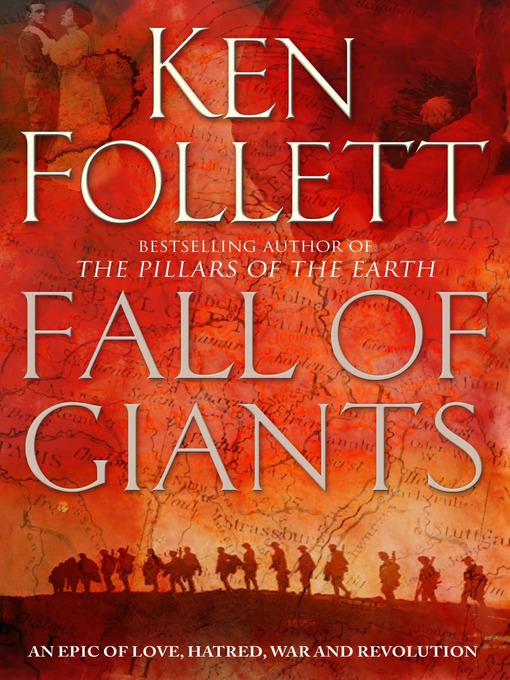
I'm a huge fan of Ken Follett's epic duology Pillars of the Earth and World Without End. Actually I'm not sure that quite covers my feelings for those books. You know those books you have on your shelf to read again and again, like old friends? Something new every time, but also something warmly comforting about them. That's Pillars of the Earth for me. Consequently I've been awaiting this Century trilogy with bated breath, but also a sort of nervous excitement. The publication at the end of last year of the final in the series led to my excited embarkation of the trilogy over Christmas.

At first I was disappointed. The excellent writing and atmospheric descriptions were there but something was missing. I think the biggest issue is the sheer number of characters. Follett has attempted something quite remarkable in telling the story of the First World War from the point of view of Welsh miners, upper-class English, Russian peasants, American, and German families. Because the characters are not introduced slowly or piecemeal, the book requires an initial heavy commitment to buy in to them all, and to fully distinguish them from each other. Just as you fully inhabit one storyline, focus switches to another character.

Having said that this commitment is quickly rewarded. If there's one thing that Follett can do it is weave an engrossing story. There is some strangely clunky text; I found descriptions such as "pints of beer in glasses" very sticky.  There are some beautiful set pieces here, and some real stand-out storylines, intermingled with some frankly unbelievable coincidences. But it's fiction! I'm not particularly educated in the details of the first world war and the descriptions of daily life the trenches on both sides as well as technical discussion of the strategies of politicians and military was fascinating.  
Sadly not as immersive as Pillars of the Earth, but definitely worth a look if you are interested in the machinations of the early part of the last century. I look forward to reading the second in the series.

864 pages

Monday, February 18, 2013

Book Review - Winter in Madrid by CJ Sansom - Kindle


556 pages

***currently 20p on Kindle!***

Oh CJ Sansom how I love you.  What a joy to read his books are.  This is the first book of Sansom's  that I have read that is not in the Shardlake series. I embarked with trepidation, because, as I have previously mentioned, I think that series is pretty near perfection.

Well, I wasn't let down. One thing that you can totally rely on Sansom for is characterisation. Every one of the characters, be they major or minor cast, are totally 3 dimensional and believable.  I've said it before in reference to Shardlake, but it is so refreshing when even the ones you are meant to love have periods of unlikeability.  

I'll admit it, recent history in Spain is not something I am knowledgeable about.  I don't even know a lot about what went on there in the second world war.  It could be that this is total nonsense, but it didn't read like it.

And the thriller part is actually thrilling.  I didn't see the twist coming at all.  That's right, I actually gasped!  Hoorah for that kind of experience when reading a book!

The one downside is the epilogue.  I strongly advise you to not bother reading it. It isn't necessary to tie all the ends up and it certainly isn't necessary to have the characters suddenly possessed by Basil Exposition in order to do it.

If you liked this try another CJ Sansom, or Robert Harris

Book Review - The Poisonwood Bible by Barbara Kingsolver


616 pages

I've been putting off reviewing this book, because I know it's going to be a hard one.  On the one hand I found it absolutely absorbing and couldn't put it down for the 3 days it took to read it. On the other hand there were several issues I had with it that riled me.  I'm going to do a lot of moody complaining in this review, so let me just say before I start that I did actually like this book.  It annoyed me, yes, but I am certainly going to be reading it again.

I was given the book by someone that didn't enjoy it at all, but when I mentioned I was reading it I had several friends tell me it was one of their all time favourites so I didn't know what I was going to think.

In a nutshell the book follows the Price family as they are transported from America to the Congo by their maniacal father who is on a mission to save the natives. It discusses three generations but really focusses on the children. In terms of plot I had a lot of time for this book.  You need to totally suspend disbelief, and I mean totally. It is astounding to the reader that a religious zealot could have been given support by any organisation to carry out a personal quest when so clearly mentally ill.  It is astonishing that such a man could drag his wife and daughters along with him with never a word of dissent from them prior to the event.  It is truly unbelievable that all of these characters come from the same family.  But then again, maybe life was just like that in the 50s and 60s, what would I know?

Barbara Kingsolver can write, she really can.  There are passages in the book that are almost painfully beautiful. The book is so evocative of a time and space in rural central Africa you can almost taste and smell it.  Why on earth she decided to employ the rather irritating plot device of writing each chapter from a different person's perspective I will never know.  The problem with this is that every single one of the central characters is a caricature.  The stupid one is an imbecile, the clever one talks in riddles, the 'normal one' is dullsville, the tragic poet spots rare animals in the forest, the religious zealot uses everything for a sermon, the cad is a irredeemable rake, the one that married a villager is perfection itself, the baby forms a natural bond with the natives...BAH! The most believable people are the supporting cast which is quite irritating.

My other annoyance?  So desperate is Kingsolver to let us know that she has researched the history of the Congo thoroughly that she has her characters mention lots of world political events, and local political events 'in passing'.  This is most irritating towards the end of the book where it really does become nonsensical the include it in the conversations. Let's just say I'm almost surprised she didn't have one of the supporting cast turn out to be the real culprit in the murder of JFK.  I really wish she had limited herself to the one generation.  After about page 400 things got rather dull and contrived as we start to follow the children when they are grown up. But who can complain really when they've been given 400 good pages!

OK gripes over.  This book is a keeper.  I don't want to let it go and I do want to re-read it.  For all that it annoyed me, it totally captured me and I suspect it's going to be on my bookshelf for many years to come. I'd love to hear your views on it, if you have read it, this is a book I wish I had read with my book group as I think it would stand up to a good afternoon of dissection, wine in hand.

If you liked this one, try The Sparrow by Mary Doria Russell or Cutting For Stone by Abraham Verghese.

Sunday, February 03, 2013

The Saltmarsh Murders by Gladys Mitchell - Book Review (AUDIO)


288 pages

If you like Agatha Christie, but wish it was a little more unusual and comedic, then this one is for you.   Yes, some of it is a little out of kilter with modern views (it was written in 1932 and the black characters are as you can imagine), but it is genuinely funny.

A blandings-esque (and I say that in the Jeeves and Wooster sense rather than the more recent adaptation) jolly romp through a complex mystery.

The audio version is read by Gordon Griffin.  He's done a marvellous job here, setting exactly the right tone.  Sometimes you listen to a book that is totally ruined by the reader, but when you get a good one the result is better than when you read it yourself.

A keeper.

Friday, February 01, 2013

Nell Sweeney Novels by Patricia Ryan - Book Review (KINDLE)


324 pages, 276 pages, 276 pages, 244 pages

I know it's a bit cheeky to lump all of these together, but I read them straight one after the other, and four posts seems a bit much. What a coincidence that two of them have exactly the same number of pages.

These are period American crime novels.  It's a genre I have avoided for some time after reading the appalling The Interpretation of Murder by Jed Rubenfeld.  Oh my that was a dreadful dreadful book.  But I digress.  These on the other hand are lovely.
For some reason I always find books containing Opium dens rather funny, but I don't know why.  There's a lot of detail in here about how to prep your opium for den activity and descriptions of the sort of paraphanalia you might need.
Otherwise it's rather likeable nonsense.  Bit of crime; bit of unqualified, unlikely detection; bit of romance; bit of stereotyping.  All in all they are easy throwaway reads, perfect for a holiday.

I'll happily read the rest when they are cheap on Kindle.

Mortal Engines by Philip Reeve - Book Review


304 pages

Firstly, I haven't posted a picture of the cover here, because this picture is so much better.  My copy has the worst cover possibly in the history of fiction.  Some very very bad decision by Scholastic has done Reeve no favours.  Happily, this error seems to have been rectified in more recent editions, and joy upon joy WETA are working of a film adaptation with Peter Jackson.  Hoorah!

So you may guess from that, I loved this book. I knew from the first sentence I was going to love this book and it didn't disappoint.

This is the first in quite a series of 4 books in the Predator Cities series. The concept of Municipal Darwinism is, as far as I am aware, wholly original.  The plot doesn't take the route you expect and it is a jolly good adventure from start to finish.
Also, for a kids book, it is pretty gory and has some properly nasty characters.  Which is nice. I'm rather ashamed that it has taken me this long to read Reeve, but I shall certainly be reading the rest of the series.

There's a couple of places where the text is slightly clunky or childish, and one incredibly flowery passage that doesn't quite sit right, but other than that I have no complaints.  Except for the cover.

You should read this.

Dissolution by CJ Sansom - Book Review


463 pages

CJ Sansom is one of the best crime writers around right now.  I'd claim that he is the best, but I haven't read all crime in existence  so I won't.  He writes a combination of two of my favourite genres: crime and history.  He clearly knows what he's talking about.
This is the first in a series of books following the life of Matthew Shardlake, a hunchbacked lawyer that gets caught up in solving crimes often against his better judgement, and often because politically it would be unwise to refuse the work.
The characterisation is excellent.  Shardlake himself is quite likeably unlikeable, which is impressive in itself.  The sights, sound and smells of the 16th century are so real that you are totally absorbed.  This is one of those proper books that sucks you in and leaves you living half in the world of the dissolution of monasteries while you try and conduct your everyday life.
I've read this one before and I'll read it again.  This series is a definite keeper, all the hardcopies are on my shelf and will stay there. Highly recommended.

Tuesday, January 29, 2013

Master and Commander by Patrick O'Brian - Book Review (KINDLE)

This year I'm trying to review all the books, TV series, and films I see so that I can keep track.  At the moment there's a bit of a glut because January was a busy month!

So yes, Master and Commander as per the title.


This was a book club read, and I had it on the 'to read' bookshelf in any case so I was quite pleased.  I'd bought it ages ago as one of those books I thought I really should get round to, so here was the perfect excuse.

I didn't not like this, because what's not to like.  OK there was a not of navy schmavy talk about different sails and ropes and whatnots, but since I found the first passage  explaining it all completely incomprehensible I just skipped over any others I came across. Now, once I got to book club I discovered that in the hard copy you get a diagram that tells you all the sails and stuff and that would have made it a hell of a lot easier, but on the e-read you don't so I was none the wiser by the end of the book.

The characters are lovely and funny and nicely observed.  I didn't totally believe them, but I didn't think they were absurd either.  I liked them, and that is the key. The captain (sorry that is probably the wrong term, another thing that's hard to understand), Aubrey, is wonderfully thick, and the doctor, Maturin, is marvelously odd. He also has a brilliant name.

Other than that there's not much to say, because nothing happens.  That's a bit harsh, but really, there's several times you hear about something happening because one of the incidental characters is talking about it, but that's it.  You hear about it in passing. Also the narrative keeps skipping in what seems like important places.  It's all set up for a big scene, and then suddenly you are somewhere else on a ship having lunch.  448 pages of a nice read, but not much going on. No wonder there's 20-odd books in the series.  I'd happily read more, but I'm not going to go and buy the set.

Having said all that and damned the thing by faint praise, there is one scene between Maturin and a French counterpart that totally makes the book for me.  I laughed out loud, which doesn't happen too often with books.

Friday, January 25, 2013

Screw your courage to the sticking place!


This book is good. No it's great.  560 pages and I read it in less than a week.  That's saying something for someone that doesn't get as much time as they would like to read.  I even shed a little tear when it finished because I didn't want it to end.  I'm not going write a full review yet, as I am reading it as part of my book group and I don't want to spoil the discussion.